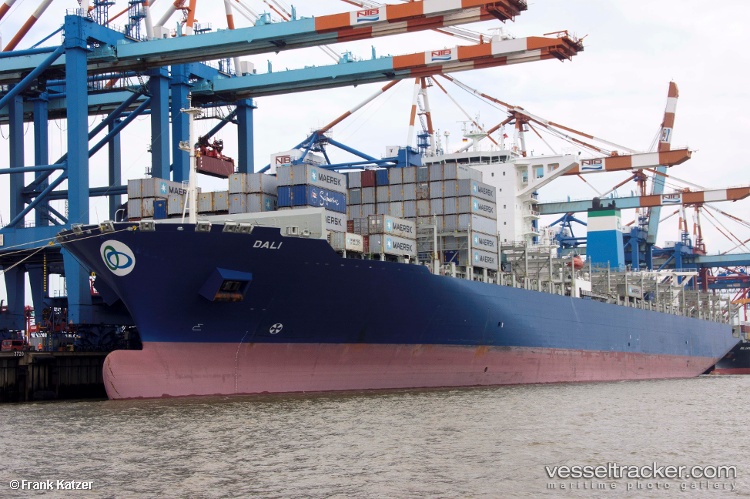
Dali
IMO: 9697428
Container Ship, Singapore
Photos
Vessel Details
MMSI
563004200
Callsign
9V5283
Width
48.0 m
Length
300.0 m
Reviews (1)
Thomas
2024-07-04
Position: Motorman
Advantages:
Looking for information about this vessel. Looking for info about this vessel? Any red flags?
Disadvantages:
No personal experience yet, just gathering info.
Latest News (11)
Insurance Company has settled with owner and operator
The insurance company ACE American Insurance Company, which underwrote the coverage for Maryland on the Francis Scott Key Bridge in Baltimore has settled with the owner and operator of the 'Dali'. The first of what could be several settlements came as U.S. District Court Judge James Bredar admonished on April 2, 2026, all involved parties to be ready for the civil trial scheduled to start on June 1. Originally, the lawyers for the claimants proposed a December 2025 trial, while the defendants’ lawyers wanted the trial in 2027. The judge had set 2025 for depositions and gathering of evidence and had long ago set the June start date. The ACE American Insurance Company, informed the court during this week’s status hearing that it had reached a settlement for $350 million with Grace Ocean, the owners of the containership, and Synergy Marine Group, which managed the 'Dali'. The amount of the settlement equalled the $350 million paid to Maryland weeks after the incident as the maximum liability under the policy. Possibly some of the other parties to the case could also reach settlements in the coming weeks, but the bulk of the case was still expected to proceed to trial. Judge Bredar early on established a two-phase process that would first hear the arguments regarding the claims of limited liability made by Grace Ocean and Synergy. The companies invoked the Limitation of Liability Act of 1851 (LOLA), which would allow the shipowner to restrict the total amount of their liability to no more than the post-accident value of the vessel, plus the value of pending freight, or approximately $44 million. Based on the outcome, the second phase would seek to apportion the liabilities. The civil trial will be heard by the judge and not go before a jury. The families of the six fatalities have filed claims, as have many local businesses. Baltimore and Maryland have claims, including for the replacement of the bridge. Estimates are that the claims exceed $5 billion. Although Maryland received the $350 million in insurance, under the law, it may still seek claims above the value of the insurance payment. Grace Ocean, Synergy, and their insurance companies have settled claims made by the U.S. Coast Guard and the federal government for the cost of the cleanup and recovery operations. The companies settled a $102 million claim with the U.S. Justice Department in Oct 2024. At the time, the companies said the settlement was not indicative of any liability, which they expressly reject for the incident that led to the collapse of the Francis Scott Key Bridge. In a separate case, the companies sought to sue the shipbuilddr Hyundai Heavy Industries, claiming defects in the construction of the ship. The ship was built in 2015, and Hyundai sought arbitration, citing the age of the ship and the years of maintenance after it left the shipyard. The trial is expected to run for several weeks and present from the hundreds of hours of depositions, as well as crew members, who have been retained in the USA thr whole time. The National Transportation Safety Board's conclusion of defects on the ship and its maintenance cannot be directly cited during the trial, but they will be able to draw from the evidence the NTSB collected during its investigation. The state marked the second anniversary of the bridge collapse by emphasising the strong rebound in its economy, and specifically the Port of Baltimore. It stated the bridge replacement project was on track, and work has begun removing more of the elements of the Key Bridge. The replacement bridge is not expected to be completed before 2030.
Changes made after delivery bypassed critical redundancies. according to HD Hyundai Heavy Industries
Thei shipbuilder HD Hyundai Heavy Industries, which built the 'Dali', said that changes made after delivery bypassed critical redundancies, triggering the second blackout that left the ship without propulsion or steering in the critical moments before the allision with Baltimore’s Francis Scott Key Bridge. The shipyard has issued a detailed defense of the 'Dali'’s original design following the National Transportation Safety Board’s investigation into the accident on March 26, 2024. The NTSB had determined that the probable cause of the allision was a loss of electrical power due to a loose signal wire connection stemming from improper wire-label banding installation, resulting in the vessel’s loss of propulsion and steering near the bridge. The agency also made a recommendation to the HD Hyundai Heavy Industries, to incorporate proper wire-label banding installation methods into its electrical department’s standard operating procedures. The shipbuilder in turn emphasized that the'Dali' was delivered with extensive redundant systems and automatic restart capabilities designed to prevent catastrophic failures, noting that such vessels have onboard power plants and are built with safeguards to deal with the inevitable unpredictability of running a complex system in a harsh environment. According to HD Hyundai, the vessel was originally equipped with four independent diesel generators, two independent transformers, and fuel supply pumps set to automatic mode that would restart without crew intervention after a power outage. These redundancies, the shipbuilder noted, are required by relevant classification societies. However, the company alleged that some time after taking possession of the 'Dali', the shipowner and operator circumvented the ship’s safeguards by compromising its critical redundancies, and claimed that the operators replaced automatic fuel supply pumps with an electrical flushing pump, a single-point system designed for cleaning, not fuel supply, that can only be restarted manually and lacks critical protections. Using the flushing pump as a fuel supply pump sacrificed both redundancy and automation of the fuel supply system and violated established classification rules. On the day of the incident, the vessel experienced two blackouts. The first was caused by a wire disconnecting from a terminal block in the transformer system. Because the transformer was being used in manual mode rather than automatic, the crew had to manually switch to the backup transformer. However, when making this switch, he crew did not restart the flushing pump that had been supplying fuel to the operating generators, starving the generators of fuel and resulting in another blackout, according to HD Hyundai. The shipbuilder contended that had the vessel’s systems been used as designed and manufactured, power would have been restored within seconds, and the second blackout, which led to the tragedy, would not have happened. The NTSB also found fault with the vessel’s operations. Although not causal to the initial underway blackout, the NTSB found that the crew’s operation of the flushing pump as the service pump for online diesel generators was inappropriate because the necessary fuel pressure for diesel generators 3 and 4 would not be automatically reestablished after a blackout- As a result, the flushing pump did not restart after the initial underway blackout and stopped supplying pressurized fuel to the diesel generators 3 and 4, thus causing the second underway blackout (low-voltage and high-voltage- The NTSB found that operational oversight by Synergy, the 'Dali'’s operator, was inadequate. The NTSB noted that routine inspection over the past decade should have identified the loose wire, while HD Hyundai emphasised that it was incumbent on the ship’s owner and operator to engage in regular and appropriate inspection and maintenance to ensure that the systems and components on the ship remained in seaworthy condition. The NTSB also identified contributing factors beyond the vessel’s systems, including the lack of bridge countermeasures and ineffective communications to warn highway workers to evacuate. The agency issued urgent recommendations to multiple federal agencies and bridge owners nationwide to assess vulnerability and implement risk reduction strategies. HD Hyundai stated that the 'Dali'’s shipowner and operator used the vessel’s systems improperly and neglected their continuing inspection and maintenance obligations. They cut corners and violated class rules, which ultimately led to the tragic incident. The company extended its condolences to the families affected and pledged to continue working with authorities to prevent similar incidents.
NTSB-Report Misplaced wire label, vulnerability of bridge and other mishaps in protocols contributed to bridge collapse
A misplaced wire label, the vulnerability of the bridge and other mishaps in protocols likely caused the collapse of Baltimore’s Francis Scott Key Bridge, when the 'Dali' struck it, according to the National Transportation Safety Board. On Dec 10, the NTSB released a 259-page final report on the March 2024 incident, which detailled the events that could have caused an electrical blackout that led to the vessel veering and smashing into the bridge, killing six highway workers. Other contributing factors to the cause of the incident were the crew’s inability to recover propulsion from the loss of electrical power, and the limited time people could act due to the 'Dali'’s proximity to the bridge. There was also a lack of effective and immediate communications to notify the highway workers on the bridge to evacuate. The NTSB did not place blame but determined probable causes of transportation incidents. The final report on the incident was revised and issued with more than 20 recommendations finalized by the NTSB. At a public meeting in November, the NTSB said it believed a wire label was put in the wrong place on a signal wire when the ship was built. That wire label, identifying the line, kept the wire from getting a good connection in a circuit breaker, which in turn ultimately caused the first blackout. The wire label is a small silicone sheath made of thermoplastic material that was heat-shrunk around the wire. It was one of many probable causes determined by the agency after their investigation. The NTSB will issue recommendations to certain groups involved or adjacent to the incident, but the groups were not required to take on these recommendations, just strongly encouraged. The vessel lost steering, the ability to operate the bow thruster, key water pumps, and most of the vessel’s lighting and equipment essential for operations. That first outage lasted 58 seconds. The crew onboard the 'Dali' quickly found the tripped breaker. Power came back within 58 seconds, but restarting a key pump that would have provided fuel to generators had to be done manually, and that didn’t happen. When the generators ran out of gas in their lines, the result was a second blackout. The Francis Scott Key Bridge had nearly 30 times the acceptable level of risk for critical bridges of collapse if it were hit, based on guidance established by the American Association of State Highway and Transportation Officials. The Maryland Transportation Authority, which maintains the bridge, never evaluated that risk. The NTSB also identified 68 other bridges in 19 states spanning waterways frequented by cargo ships that, like the Key Bridge, were built before 1991 and do not have a current vulnerability assessment. Transportation Secretary Sean Duffy would meet with Maryland Governor Wes Moore to discuss the state’s handling of key projects, including the bridge, for which costs have risen. Duffy sent a letter in September to Moore raising concerns over the budget and timeline. The Maryland Transportation Authority said the updated cost estimate to replace the Key Bridge was now projected to be $4.3 billion to $5.2 billion, with an expected opening in late 2030, a two-year delay from the earlier estimate.
NTSB synopsis: Labeling band on a single signal wire caused blackout which led to fatal allision
A labeling band on a single signal wire caused the electrical blackout that led to the 'Dali'’s allision with Baltimore’s Francis Scott Key Bridge on March 26, 2024, the National Transportation Safety Board revealed in a synopsis on Nov 18. The investigation found that wire-label banding prevented the wire from being fully inserted into its terminal block spring-clamp gate, causing an inadequate connection in the electrical system. When the wire electrically disconnected, a high-voltage breaker opened unexpectedly, triggering a cascade of events that resulted in the loss of propulsion and steering as the ship departed from the port of Baltimore. The initial blackout occurred at approximately 01.29 a.m., cutting power to critical systems including steering gear pumps, the fuel oil flushing pump, and main engine cooling water pumps. After the blackout, the vessel’s heading began swinging to starboard toward Pier 17 of the bridge. Despite efforts by the pilots and bridge team to alter the vessel’s trajectory, the loss of propulsion rendered their actions ineffective. When the vessel struck the southern pier supporting the bridge’s central span, a substantial portion of the structure collapsed into the Patapsco River. Portions of the pier, deck, and truss spans fell onto the vessel’s bow and forwardmost container bays. Six members of a seven-person road maintenance crew died in the collapse. One highway worker survived with serious injuries, and an inspector escaped unharmed. One of the 23 persons aboard the 'Dali' suffered a minor injury. The NTSB determined the probable cause to be the “loss of electrical power (blackout), due to a loose signal wire connection to a terminal block stemming from the improper installation of wire-label banding, resulting in the vessel’s loss of propulsion and steering close to the bridge. Contributing to the collapse of the Key Bridge and the loss of life was the lack of countermeasures to reduce its vulnerability to collapse due to impact by ocean- going vessels, which could have been implemented if a vulnerability assessment had been conducted by the MDTA as recommended by AASHTO. Also contributing to the loss of life was the lack of effective and immediate communications to notify the highway workers to evacuate the bridge.” The NTSB investigation identified additional safety concerns beyond the immediate cause. The vessel’s main engine was configured to shut down due to low cooling water pressure—a design that met classification standards at the time of construction but endangered the ship when the cooling pump lost power. Investigators also found issues with the flushing pump being used as a fuel service pump for diesel generators, a role for which it lacked redundancy. The investigation revealed that infrared thermal imaging could have identified the loose wire if it had been used to inspect the 'Dali'’s high-voltage switchboard connections as part of the vessel’s preventative maintenance program. Contributing to the severity of the incident was the bridge’s vulnerability to large vessel strikes. As part of the investigation, the NTSB expanded its focus beyond Baltimore, sending letters to 30 owners of major spans over navigable waterways across the country. The agency urged these bridge owners to evaluate how vulnerable their structures are to strikes from today’s much larger ocean-going vessels and, where necessary, develop concrete risk-reduction plans. This directive requires owners to apply long-standing AASHTO (American Association of State Highway and Transportation Officials) guidance on vessel-collision design, calculate collapse risk probabilities, and consider real-world countermeasures—from fendering and structural upgrades to motorist warning systems and traffic controls. The Key Bridge collapse is being treated not as an isolated incident, but as a wake-up call for every aging, ship-exposed bridge in the U.S. maritime system. The NTSB found that quick actions by the 'Dali'’s pilots, shoreside dispatchers, and the Maryland Transportation Authority to stop bridge traffic prevented greater loss of life. The damage to the 'Dali' exceeded $18 million, with cargo damages undetermined. Bridge replacement costs were estimated between $4.3 billion and $5.2 billion, with completion anticipated in late 2030. Over 34,000 vehicles that formerly traveled over the Key Bridge daily—including 10% trucks and all vehicles carrying hazardous materials prohibited from using Baltimore’s tunnels—must now take extended detours. Grace Ocean and Synergy Marine Group, the vessel’s owner and manager said they would review the Board’s findings “in detail with their technical teams, the vessel owner and counsel. Eight Dali crew members have remained in the United States to support the investigation. Four have now been granted permission to visit their families in early December. The NTSB issued 18 new safety recommendations to multiple organizations, addressing issues ranging from vessel redundancy and electrical maintenance to bridge protection and emergency communication.
The NTSB is to determine the probable cause of the Baltimore Bridge collapse
A meeting of the National Transportation Safety Board, scheduled for Nov 18. will address electrical failures that led to tje allision of the 'Dali' with the Francis Scott Key Bridge on March 26, 2024. The NTSB board will vote on findings, probable cause, and safety recommendations, as well as any changes to the draft final report. A synopsis will be available after the meeting concludes, with the complete final report expected several weeks later. The accident unfolded rapidly in the early morning hours. At approximately 01:25, the first blackout occurred when the 'Dali' was 0.6 miles from the bridge, shutting down the main propulsion engine and all steering pumps while the vessel traveled at 9.0 knots. Despite crew efforts to restore power, a second blackout struck when the ship was only 0.2 miles from the bridge. Pilots called for tug assistance and ordered an anchor drop, while authorities scrambled to close the bridge to traffic. However, only maintenance workers and an inspector remained on the structure when the 'Dali' struck the pier 17 at 01:29 a.m. Of the eight people on the bridge, six construction workers were killed, one survived with serious injuries, and one inspector escaped unharmed. The NTSB will convene a public board meeting to determine the probable cause of the incident that claimed six lives and exposed systemic vulnerabilities in America’s aging bridge infrastructure. The vessel had experienced a complete loss of electrical power and propulsion while transiting out of Baltimore port, striking the bridge’s southern pier at approximately 6.5 knots and triggering the collapse. The NTSB investigators have identified critical issues with the 'Dali'’s electrical systems. The vessel experienced two separate blackouts during its approach to the bridge, with electrical breakers HR1 and LR1 unexpectedly tripping when the ship was just three ship lengths away. The investigators discovered an interruption in the control circuit for HR1’s undervoltage release and subsequently removed a terminal block from the circuit for examination at the NTSB Materials Laboratory. The ship had also experienced two in-port blackouts the day before the accident, with crews switching the electrical bus configuration in response. The NTSB disclosed that the Francis Scott Key Bridge had a risk level nearly 30 times above the acceptable threshold for critical bridges, a fact that could have been discovered had the Maryland Transportation Authority conducted a recommended vulnerability assessment. The investigation has identified 68 bridges across 19 states requiring immediate vulnerability assessments, including high-profile structures like the Golden Gate Bridge, Chesapeake Bay Bridge, Verrazano Narrows Bridge, and Greater New Orleans Bridge. All were designed before current safety guidelines were established and lack current vulnerability assessments for vessel collision risks. The investigation has already prompted four urgent safety recommendations to bridge owners, the Federal Highway Administration, the U.S. Coast Guard, and the U.S. Army Corps of Engineers to safeguard bridges from vessel strikes.
Claimants asked to remove liability cap for manager
Claimants in the litigation case over the 'Dali' allision with the Francis Scott Key Bridge in Baltimore were asking a judge to remove a liability cap from Singapore ship manager Synergy Marine. Lawyers for a coalition of claimants, including the state of Maryland, have argued that the law that limited liability in shipping casualties, was applying only to the shipowner, not the manager. They filed a petition in the US District Court for the District of Maryland 18 months after the accident.
Owner and operator filed lawsuit against Hyundai Heavy Industries
On July 31, the Grace Ocean Private Ltd. and the Synergy Marine Private Ltd, the owner and operator of the 'Dali', have filed a lawsuit against Hyundai Heavy Industries (HHI), the builder of the container ship. The lawsuit alleged that the ship's allision with the Francis Scott Key Bridge was caused by HHI's negligence, stating that a "defective design" is what led to the loss of power on the ship. In the complaint filedin the U.S. District Court for the Eastern District of Pennsylvania, Grace Ocean (the registered owner of Dali) and Synergy Marine (its technical manager) alleged that Hyundai improperly engineered and installed a key component of the ship’s electrical distribution system. The claim centred around an under-voltage release (UVR) mechanism tied to one of the ship’s main circuit breakers. The lawsuit stated that a loose wire at node 381 on the ship's electrical switchboard caused a power outage, which led to the engine shutting down and a loss of steering. According to court documents, two minutes after the power went out, a complete electrical blackout occurred. At 1:28 a.m., the ship allided with the Francis Key Bridge. The plaintiffs contended that the wiring connection, which was designed to carry control signals, was compromised due to the incorrect placement of a labelling band, preventing secure contact within the terminal block. This flaw disrupted the power supply and ultimately led to a full-scale electrical shutdown. U.S. federal authorities, including the National Transportation Safety Board and the Coast Guard, had earlier identified issues within the vessel’s electrical infrastructure as pivotal in their investigation. A report released in June had confirmed a break in continuity within the control circuit. Additional technical assessments documented loosely secured cabling, which engineers from Hyundai reportedly acknowledged could lead to system failure—a conclusion later substantiated during controlled simulations. The 'Dali' had suffererd prior electrical anomalies, including a blackout while docked in Baltimore shortly before its final voyage. These prior events, combined with reports of degraded maintenance conditions and makeshift onboard repairs, have raised serious concerns over the vessel’s operational integrity and its compliance with maritime safety standards. Apart from the lawsuit, Grace Ocean and Synergy Marine are also facing significant legal challenges. The U.S. Department of Justice filed a separate $100 million action in Sep 2024, accusing the companies of knowingly operating an unseaworthy ship and failing to disclose mechanical and electrical deficiencies. The State of Maryland has also launched litigation, seeking financial recovery for damages related to the bridge’s destruction, emergency response costs, and infrastructure restoration. As a defense strategy, the ship’s owner and operator have been seeking to limit their liability through maritime law provisions while redirecting part of the responsibility toward the original equipment manufacturer. Their suit against HD Hyundai includes claims for the cost of vessel repairs and potential compensation across dozens of civil cases involving economic loss, property damage, cargo disruption, personal injuries, and environmental impacts. The construction of the 'Dali' had started in 2014, with the delivery in 2015. The current product liability action accused Hyundai of failing to ensure that all electrical connections on the switchboard were properly secured during fabrication and assembly, and that the system was unsafe from the point of delivery. HD Hyundai has been formally notified of the suit and is expected to respond through legal channels in the coming weeks. This litigation adds a new layer of complexity to an already expansive network of legal proceedings stemming from one of the most consequential maritime incidents in recent U.S. history. A report released by the National Transportation Safety Board in 2024 stated that a cable that was supposed to connect with a control for blackout detection was loose. If not properly connected, the switchboard can lose power without ever being recorded on the ship's sensor, per the NTSB report. The lawsuit stated that HHI knew about the possibility of loose wires in the switchboard and knew, or should have been aware the vessel was at risk of power outages. Grace Ocean Private Limited and Synergy Marine PTE have since denied any wrongdoing since April 1, 2024. 45 claims are currently pending for property damage, economic damages, clean-up costs, personal injury, wrongful death, survival, workers' compensation reimbursement, and cargo and general average.
Hyundai claimed for manufacturing defect
As a federal court in Baltimore continued to hear pre-trial motions and collect evidence for the claims pending related to the 'Dal'’ 2024 incident, the owner and operator of the vessel are now suing the builders of the vessel alleging negligence or gross negligence in the design, construction, and/or manufacture of the critical switchboard which has become the focus of the investigations into the cause of the blackout aboard the vessel. The National Transportation Safety Board and the teams from the U.S. Coast Guard and other agencies investigating the cause of the allision with the bridge quickly centered in on the power supply, critical circuit breakers, and the switchboard for the ship’s electrical systems. It has long been recognized that something caused the vessel’s breakers to trip, shutting off the power to the motor and critical systems, including the hydraulics to control the rudder. As early as June 2024, it came out that the NTSB had found "an interruption in the control circuit” linked to the main breakers. A subsequent report revealed that a check of the wiring on the transformer and a relay found a “cable was loosely connected,” a condition which representatives from the shipbuilder Hyundai informed could create an open circuit and interrupt the 110VDC power on the HV side of the board. According to the report, the engineers said it would trigger an under-voltage release trip, which would result in a 440V blackout, and they later demonstrated it in tests. In a suit filed on July 31 in the U.S. District Court, Eastern District of Pennsylvania, the owners of the 'Dali', the Grace Ocean, and the operators of the vessel, the Synergy Marine, alleged, Hyundai Heavy Industries defectively designed the switchboard in such a manner that wiring connections were not secure, could not be verified as secure, and could lose connection during normal operation, such that the signal wire was not designed to remain securely connected to the terminal block, which design defect caused the switchboard and the vessel to be unreasonably dangerous and in a defective condition when it left HHI’s control. The court filing revealed that a UVR coil for the circuit breaker was not receiving control voltage, and that it was discovered that one of the control signal wires in the UVR control circuit was not securely connected to its terminal block.Because the signal wire was not securely connected, the insufficient contact created an open circuit. The suit alleged the wire was not securely connected because the “labeling band identifying the wire was installed too close to the ferrule crimped on the end of the wire.” It goes on to assert, “As a result of this and other defects, the signal wire could not be inserted fully into the terminal block’s spring clamp gate.” The companies are seeking the cost of damage to the vessel and resulting repair costs as well as contribution and/or indemnity as it relates to the 45 claims ranging from property damage to economic damages, clean-up costs, personal injury, wrongful death, survival, workers’ compensation reimbursement, and cargo and general average in the Maryland civil case. The court is set next year to hear the first of two phases in that case centered on Grace Ocean and Synergy Marine’s limitation of liability claim, and based on that outcome, the potential size of the liability. There have been multiple reports about power problems and failures on the vessel before that night, including at the dock in Baltimore. The NTSB, in its reports, has also highlighted the maintenance of the vessel, citing examples of wear and makeshift repairs. The U.S. has claimed the vessel was not seaworthy, and Maryland and Baltimore, in their claims, cite the training and maintenance of the vessel. Hyundai Heavy Industries has been served in the product liability case and will file its response in due course. This will start the parallel case seeking to place blame for the defects found on the vessel.
New details of technical conditions emerged during investigations of lawyers
New details have emerged about the condition of the 'Dali', as the lawyers gathered information about the ship and continued their discovery process and interview crew members. New revelations from lawyers representing the state of Maryland and other claimants seeking damages from the owner company Grace Ocean Private, and the managers of the Synergy Marine Group, included brake failures on one of the anchors. The hydraulic brake on the port side anchor windlass had been inoperable for nearly two weeks,.The unseaworthy condition meant the anchor windlass could only be operated with the manual brake, a two-man job. Despite that situation, only one man was posted to the bow on March 26, 2024, which meant when the time came to deploy the anchor, he was unable to do so. The lawyers alleged that that had devastating consequences for properly diverting the ship from disaster. Additionally, the documents stated that the ship was without one of its four generators. The crew only ran two of the three remaining generators as it left port. The Chief Engineer admitted that the second blackout would never have occurred if the ship had been using three generators rather than two. The state of Maryland, the city of Baltimore, numerous companies and families of the victims who died on the bridge are all suing the Grace Ocean and Synergy. Depositions have been taken from the crew, but the testimony remains redacted at this time. Earlier, the Maryland Attorney General’s Office asked ZeroNorth for its communications information with Grace Ocean as part of the discovery phase of the case. ZeroNorth owns the software SMARTShip, which is used to remotely monitor vessels. The communications of the owners and managers of the 'Dali' with Alpha Ori and ZeroNorth will be critical in establishing how SMARTShip was utilized onboard the ship, and what information shoreside personnel chose to monitor. The trail Grace Ocean and Synergy is set for next summer.
Hours before Key Bridge allision, blackouts were discussed by captain
Eight hours before the 'Dali' allided with the Francis Scott Key Bridge, the master Chandrashekar Sabhapathy spoke with its chief engineer. while the vessel, was berthed at the Port of Baltimore on March 25, 2024. It had just experienced two blackouts, and the captain wanted the engineer to comprehensively complete an incident report for the ship’s office. “For now, put the data reporting date as the28,” the captain told the engineer, which was was three days after the incident. Filing a written report days after an incident is permitted; the U.S. Coast Guard allows five days for a ship to report a marine casualty. The Department of Justice alleged in its lawsuit in 2024 that the 'Dali' did not notify the Coast Guard immediately after addressing the safety concerns, violating federal regulations. Reporting the in-port blackouts could have prompted a Coast Guard inspection. The Coast Guard was conducting a thorough review of all events preceding the allisiion. Some experts said that the crew acted appropriately by creating a comprehensive report that it would later file. Others saud that evidence shoed that an important safety step was skipped prior to the departure from Baltimore. The recently released NTSB documents shed light on the previous afternoon, 10 hours prior to the accident, when the ship twice lost power at the Seagirt Marine Terminal. Alarms sounded intermittently for more than 30 minutes beginning at 2:20 p.m. “Something is missing,” one crew member said in Hindi. “Look there — close to that,” another said. At one point, the alarms ceased, and it was quiet enough for a recording to pick up the sound of a utensil stirring coffee in a ceramic cup. Then, the sirens picked back up. At 5:49 p.m. the master instructed the chief engineer to fill out an “incident report,” and that he wanted the engineer to do so because the “incident was related to the engine room", stressing that he wanted that information as soon as possible but the report itself could be submitted at a later date. The 'Dali' left Baltimore on MArch 26 at around 12:30 a.m. and lost power again four minutes before crashing into the Key Bridge. A dozen members of the crew remained in the Baltimore area, while the federal investigations continued. Chandrashekar Sabhapathy was deposed by the federal government on Feb. 17 at the Baltimore Marriott Waterfront.
Transcript reveals moments of terror, panic and uncertainty aboard the 'Dali
A transcript reveals moments of terror, panic and uncertainty aboard the 'Dali' before and after it allided with the Francis Scott Key Bridge. The transcript of audio recordings is part of the National Transportation Safety Board’s investigation into the aaident and shows that most of the conversations on board the 'DaliÄ were mundane prior to the ship losing power. The conversations included talks about the ship’s journey and even a coffee order. Early in the morning of March 26, 2024, it was business as usual. As the ship was still alongside Seagirt Marine Terminal, the ship's crew on the bridge was "having casual conversation." Around midnight, the 'Dali' began departure preparations. Pilots boarded the vessel at approximately 00:05 a.m., and standard checks were conducted: draft verification, engine blow-through, tug arrangements, and telegraph tests. Two tugs, the 'Eric McAllister' and 'Bridget McAllister', were positioned forward and aft respectively. At 00:16:02, the pilot asked the Master, “Captain, everything’s working?” to which the Master replied, “Yeah, everything is in order.” That reassurance came despite the earlier alarms and incident report request just hours before. The conversation between the Pilot and the Training pilot was ordinary. They were talking about where the training pilot lived and when they started the job. The Pilot mentioned he had stepped on a staple at home. There was conversation about people wanting sugar in coffee. At 00:34:26 a.m., the pilot told the training pilot that the voyage was “pretty straightforward” and remarked that the Portable Pilot Unit (PPU) “really makes it a lot easier,” especially for wider ships. At around 1:25 a.m. the vessel’s power cut off about 0.6 miles from the Key Bridge. At exactly 1:25:03, a.m. the ship’s alarms sounded. The 2nd Officer attempted to call the engine room, but received no response. At 01:28:16, a.m. he reported a critical loss: “We do not have bow thruster.” According to the transcript, the pilot asked the 2nd officer on board: “Do we have steering?” The second officer replied: “We have steering.” But the alarms kept going off and began to change in tone. The Training Pilot then said, "uh oh." Over the next minute, there was chaos on the cargo ship as crew members and the Pilots worked to respond to the loss of power. At 1:26:01 a.m., the Training Pilot said, "Security call. Security call. Container ship Dali has lost power. Approaching the Key Bridge - I repeat - the container ship Dali has lost all power approaching the Key Bridge - Dali." At around 1:27 a.m., the pilot shouted for the crew to use the “bow thrusters.” While the crew tried, at 1:28:56 a.m., the second officer shouted, “It’s not working.” Shortly after 01:27:00, the pilots issued calls for tug assistance and to drop anchor, and the bridge was ordered closed to traffic. Tragically, six road workers remained on the span. The 'Dali' struck the bridge’s pier 17 at 01:29:10, a.m. collapsing six bridge spans. The audio recording picked up an "enormous rumble, when the Dali hit the Key Bridge. The training pilot radioed the Coast Guard at 01:29:37, stating, “Coast Guard. Coast Guard. This is Dali. We have a major problem. The Key Bridge is down. I repeat, the Key Bridge is down.”The transcript notes all the crew members began shouting expletives before the pilot yelled, “Call the Coast Guard.” At 1:29:37 a.m., the training pilot on board the 'Dali' radioed a message, saying: “We have a major problem. The Key Bridge is down. I repeat, the Key Bridge is down." The post-collision recording captured confusion on the bridge amid blaring alarms in the minutes that followed. The Coast Guard inquired about the vessel’s position; the plot responded that they were “under the Francis Scott Key Bridge. The crew and pilots discussed the potential for casualties on the bridge and damage to the vessel. At one point, the Master was heard stating over the phone that water was running into the vessel and containers had broken loose, but that there was “no oil sheen” visible. The final alarm ceased at 02:25 a.m. In the minutes after the bridge collapsed, the pilots on the ship were trying to figure out what went wrong. "I called [the pilot dispatcher] when we started to drift," the pilot said. "But we had good speed," he added. "We weren't going crazy... everything was under control." As for the crew members on board the 'Dali', some — including the ship’s captain and other officers — remain in Baltimore as legal cases progress.
Frequently Asked Questions
🌊 Did Dali sink or have any sinking incidents?
Based on available news reports, Dali has been mentioned in connection with sinking-related incidents. There have been 4 news reports mentioning sinking incidents. For detailed information about specific incidents, please refer to the latest news section above.
🤕 Were there any injuries or accidents on Dali?
Based on available news reports, Dali has been mentioned in connection with injury-related incidents. There have been 8 news reports mentioning injury incidents. For detailed information about specific incidents, please refer to the latest news section above.
🚫 Are there any sanctions against Dali?
Based on available news reports, Dali has been mentioned in connection with sanction-related incidents. There have been 1 news reports mentioning sanctions. For detailed information about specific incidents, please refer to the latest news section above.
🛠️ Did Dali experience any breakdowns or mechanical failures?
Based on available news reports, Dali has been mentioned in connection with breakdown-related incidents. There have been 7 news reports mentioning breakdowns. For detailed information about specific incidents, please refer to the latest news section above.
🏴☠️ Was Dali involved in any pirate attacks?
Based on available news reports, Dali has been mentioned in connection with pirate-related incidents. There have been 2 news reports mentioning pirate attacks. For detailed information about specific incidents, please refer to the latest news section above.
⚙️ Did Dali have any engine problems?
Based on available news reports, Dali has been mentioned in connection with engine-related incidents. There have been 9 news reports mentioning engine problems. For detailed information about specific incidents, please refer to the latest news section above.
💥 Was Dali involved in any collisions?
Based on available news reports, Dali has been mentioned in connection with collision-related incidents. There have been 8 news reports mentioning collisions. For detailed information about specific incidents, please refer to the latest news section above.
🛢️ Did Dali have any oil spills or pollution incidents?
Based on available news reports, Dali has been mentioned in connection with spill-related incidents. There have been 3 news reports mentioning spills. For detailed information about specific incidents, please refer to the latest news section above.
🚓 Was Dali detained or arrested?
Based on available news reports, Dali has been mentioned in connection with detention-related incidents. There have been 1 news reports mentioning detentions. For detailed information about specific incidents, please refer to the latest news section above.