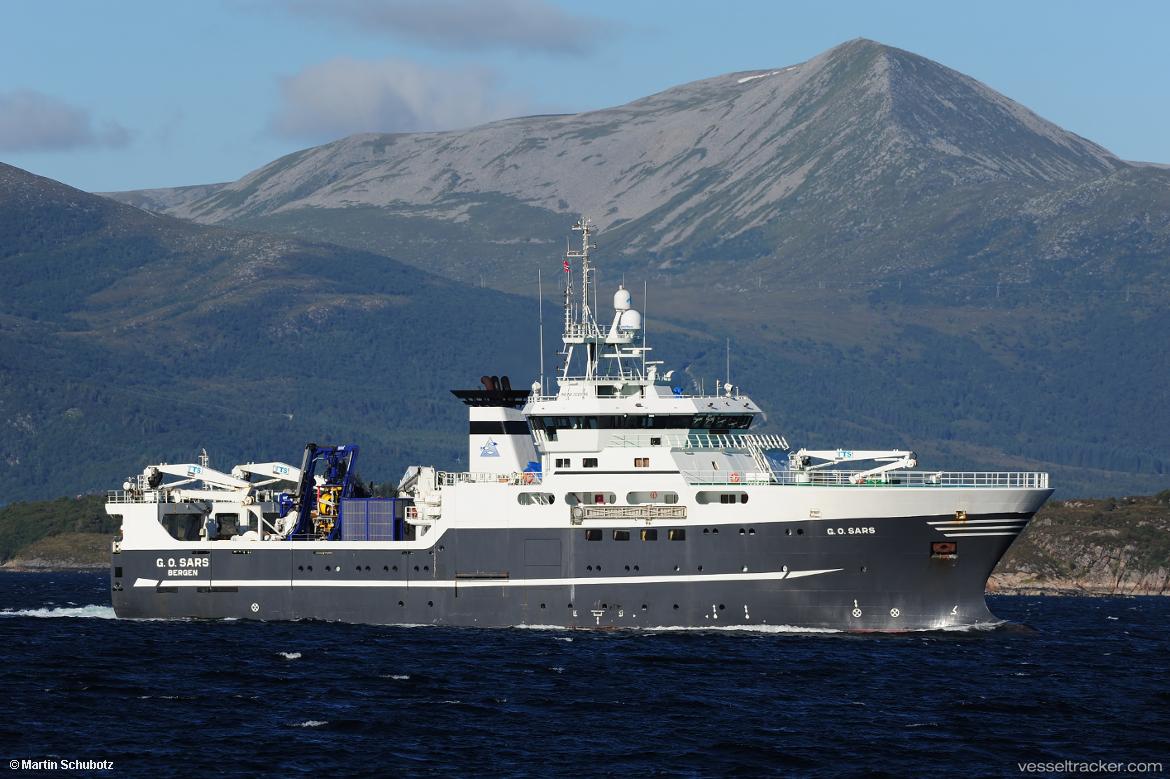
G.o.sars
IMO: 9260316
Fishing Vessel, Norway
Photos
Vessel Details
MMSI
257105000
Callsign
LMEL
Width
18.0 m
Length
78.0 m
Reviews (1)
Eugene
2024-10-31
Position: Storekeeper
Advantages:
Looking for information about this vessel. Has anyone worked on this boat? Any red flags?
Disadvantages:
No personal experience yet, just gathering info.
Latest News (2)
Report of survey of Komsomolets wreck published
On March 23, 2026, the Norwegian Radiation and Nuclear Safety Authority in Tromsø published a report on the nuclear powered Russian submarine 'Komsomolets', which sank with nuclear weapons onboard on April 7, 1989, while sailing in the European Arctic Ocean. Between Norway and Svalbard, a fire broke out in the stern at a depth of approximately 400 meters. To enable the submarine to surface, air was pumped into the ballast tanks. It was suspected that the line to the port ballast tank failed, allowing high-pressure air to enter bulkhead 7 and causing the fire to spread explosively. The submarine did reach the surface, but the fire caused a leak, and the submarine sank. Only 27 of the 69 people on board survived. Since then, the 'Komsomolets' has lain at a depth of nearly 1,700 meters. The Soviet Union and later Russia investigated the wreck. To prevent radioactive contamination, the torpedo tubes and other openings were sealed with titanium plates in 1994. Norway has been monitoring the wreck since 2013. In 2019, researchers conducted investigations and took samples using ROVs, The results showed that the titanium seals were still intact. No traces of plutonium from the warheads in the torpedo room were found in the immediate vicinity of the damaged forward section of the submarine. The events of the Cold War propagated societal fears concerning radioactive contamination that persist to this day. Therefore, it was essential to assess and communicate the risks associated with any possible exposure to radioactivity. Considering the global increase in military activities and geopolitical tensions, the fate of Komsomolets and the nuclear material within it can provide us with important insights as to impacts of any future accident involving nuclear powered vessels and nuclear weapons at sea. The study documented in detail the extent of damage to the exterior of the 'Komsomolets', and that previous remedial action carried out by Russia was still in place. No evidence was found of any plutonium in the near environment around the damaged forward section of the submarine from the nuclear warheads that were reported to be part of the armament in the torpedo compartment. It was confirmed that releases from the reactor were still occurring, but not continuously, with maximum activity concentrations of 90Sr and 137Cs that were 400,000 and 800,000 times higher, respectively, than typical levels of these radionuclides in the Norwegian Sea. Elevated levels of 239Pu, 240Pu, and 236U were also detected in the releases from the reactor, with atom ratios of 240Pu/239Pu and 236U/239Pu that indicate that the nuclear fuel in the reactor is corroding. Despite that releases from the reactor have occurred for over 30 y, there is little evidence of any accumulation of radionuclides in the near environment around the submarine as the released radionuclides appear to be rapidly diluted in the surrounding seawater. Releases from the reactor in the 'Komsomolets' were expected to continue, so further investigations should be carried out to determine the mechanisms behind the observed releases, the corrosion processes that were occurring within the reactor and the implications of these for further releases and the fate of the remaining nuclear material in the reactor. Participation of scientific personnel, sample preparation, and analyses were financed by Institute of Marine Research and the Norwegian Radiation and Nuclear Safety Authority’s funding from the Norwegian Ministry of Foreign Affairs and through the Norwegian University of Life Science’s funding from the Research Council of Norway through the Centre for Environmental Radioactivity Centre of Excellence funding scheme (223268/F50) and partially through its grant to the Norwegian Nuclear Research Centre (Project No. 341985). The surveys were carried out with the 'G.O. Sars' and the ROV 'Ægir 6000'. A/Prof. S.G. Tims, Prof. L.K. Fifield, and Drs. M.B. Froehlich, and S. Pavetich from the Department of Nuclear Physics and Accelerator Applications carried out Accelerator Mass Spectrometry measurements, which were performed at the Heavy Ion Accelerator Facility at the Australian National University, with the support of the National Collaborative Research Infrastructure Scheme of the Australian Government. Full report: https://www.pnas.org/doi/abs/10.1073/pnas.2520144123
Lost British submarine identified off Norway
The wreck of the British submarine HMS 'Thistle' has been discovered and identified in the North Sea, off south-western Norway, after had been missing for 83 years, since being sunk by a German U-boat during World War Two. During an expedition to map seabed geology and biology, the 'G.O. Sars', in spring 2023, had revealed an anomaly at a depth of 160 meters, with ROV-mounted cameras revealing it to be that of a submarine. Only in October, however, following a second ROV dive, has imagery been produced to enable the Royal Navy to confirm its identity. The surveys were part of the MAREANO project, which has been run since 2006 by Norway’s Institute of Marine Research (IMR), Geological Survey of Norway and Norwegian Mapping Authority. The team had already come across four wrecks on the spring expedition when the 'Thistle' mark showed up. Of the five, only the cargo ship 'Azalea', sunk in 1990. had been previously known about. The onboard research indicated that the submarine was likely to be a British vessel, but initially it seemed more likely to have been HMS 'Oxley', lost just before WW2, rather than the 'Thistle (N24)', a T-class submarine launched in October 1938 and missing since April 9, 1940, with the loss of all 53 crew. After the expedition, submarine experts suggested that HMS 'Thistle' was the more likely option of the two, but it took more detailed images captured by the ROV ÆGIR 6000 during the October MAREANO voyage to the Skagerrak to settle the matter with the small caveat that it is the Royal Navy that is responsible for the final identification. Report with photos: https://divernet.com/scuba-news/wrecks/british-ww2-sub-wreck-located-off-norway/
Frequently Asked Questions
🔥 Were there any fires on G.o.sars?
Based on available news reports, G.o.sars has been mentioned in connection with fire-related incidents. There have been 1 news reports mentioning fire incidents. For detailed information about specific incidents, please refer to the latest news section above.
🌊 Did G.o.sars sink or have any sinking incidents?
Based on available news reports, G.o.sars has been mentioned in connection with sinking-related incidents. There have been 2 news reports mentioning sinking incidents. For detailed information about specific incidents, please refer to the latest news section above.
🤕 Were there any injuries or accidents on G.o.sars?
Based on available news reports, G.o.sars has been mentioned in connection with injury-related incidents. There have been 1 news reports mentioning injury incidents. For detailed information about specific incidents, please refer to the latest news section above.
💥 Was G.o.sars involved in any collisions?
Based on available news reports, G.o.sars has been mentioned in connection with collision-related incidents. There have been 1 news reports mentioning collisions. For detailed information about specific incidents, please refer to the latest news section above.
🛢️ Did G.o.sars have any oil spills or pollution incidents?
Based on available news reports, G.o.sars has been mentioned in connection with spill-related incidents. There have been 1 news reports mentioning spills. For detailed information about specific incidents, please refer to the latest news section above.